Building is Easy Now. Getting Noticed is the Hard Part.
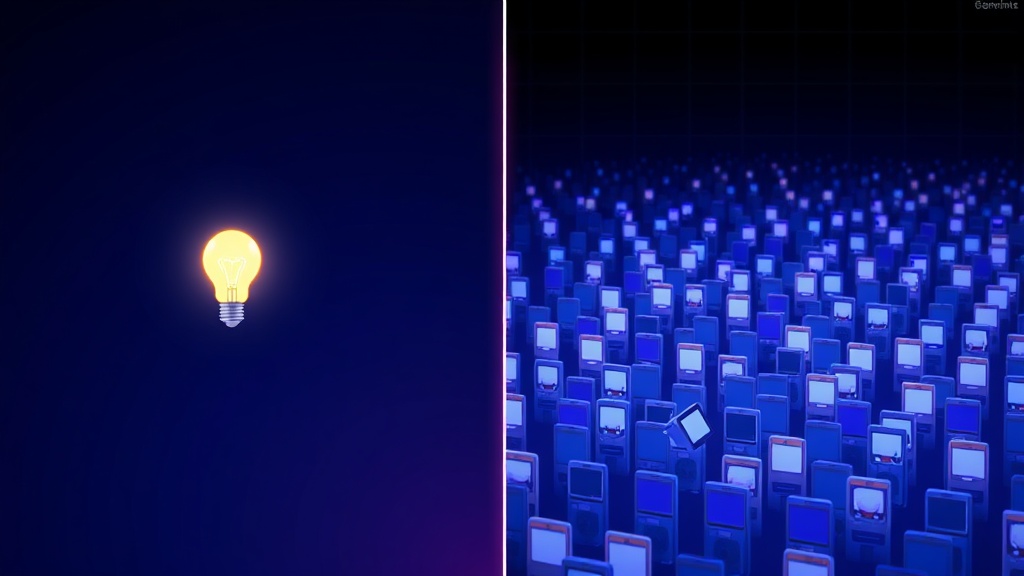
Building software has never been easier. Getting it noticed has never been harder. AI tools like Cursor and Claude let founders ship apps in a weekend — but the App Store has 2 million apps, and Product Hunt launches 50+ products daily. The bottleneck has shifted from creation to distribution, and most builders aren’t equipped for it.
Key Takeaway: AI collapsed the barrier to build software. The next frontier is collapsing the barrier to market it. The founders who win won’t be the best builders — they’ll be the ones who solve distribution.
a16z recently published a piece called “Software’s YouTube Moment is Happening Now”. Their thesis: LLMs have collapsed the barriers to software creation. Anyone can ship an app in hours, not weeks. We’ve entered the “YouTube era” of software.
They’re right. And they’re missing half the story.
The YouTube Analogy, Completed
YouTube didn’t just democratize video creation. It democratized distribution.
Before YouTube, you could theoretically make a video with a camcorder. But getting it seen? That required TV networks, film distributors, or burning DVDs and handing them out. YouTube solved both problems: create AND distribute.
Software’s “YouTube moment” has solved creation. A founder can go from idea to working app in a weekend using Cursor, Replit, or Claude. The barriers have genuinely collapsed.
But where’s the distribution layer?
The App Store has 2 million apps. Product Hunt launches 50+ products daily. Your beautifully vibe-coded app is one of thousands shipping this week.
Building is easy now. Getting noticed is the hard part.
The New Bottleneck: Attention
Here’s the irony of democratized creation: it makes distribution harder, not easier.
When only well-funded teams could ship software, competition for attention was limited. Now that anyone can build, everyone is building. The supply of software has exploded. The supply of human attention has not.
The indie hacker who ships an app in a weekend still needs weeks of:
- Crafting positioning and messaging
- Building a social presence
- Creating content that cuts through noise
- Running campaigns across channels
- Maintaining brand consistency everywhere
Technical founders are great at building. Most are not great at getting noticed. The same skills that let you ship fast don’t help you market well.
a16z celebrates that “there has never been a better time for creative young people with great ideas.” True. But ideas that no one discovers might as well not exist.
The Parallel Democratization
If AI collapsed the barrier to build, shouldn’t it also collapse the barrier to market?
Same principle:
- Idea → shipped product in hours (solved by Cursor, Claude, Replit)
- Idea → shipped brand in hours (this is the gap)
The tools exist. AI can generate content, maintain brand voice, manage multi-channel presence, and execute campaigns. What’s been missing is orchestration—an AI that understands your brand deeply and can operate as your marketing function, not just a content generator.
This is what we’re building with Lane—an AI CMO that joins your Slack, your meetings, your WhatsApp. Not a tool you use, but a team member that operates.
The founder who ships in a weekend should be able to launch their brand in a weekend too.
But Here’s What Almost No One is Talking About
Human distribution might not even be the main game for long.
Consider how discovery is shifting:
Today: Human searches Google → Human reads reviews → Human decides
Tomorrow: Human asks AI agent → Agent researches options → Agent presents shortlist → Human chooses from AI-curated options
Soon: Agent needs a solution → Agent discovers providers → Agent evaluates and transacts → No human in the loop
This isn’t speculation. 85% of organizations have adopted AI agents in at least one workflow. Google’s A2A protocol has 150+ supporting organizations. Agentic commerce is estimated at $3-5 trillion by 2030.
Your next “customer” might be a procurement agent, not a procurement manager. An AI assistant researching tools for its human. Another company’s agent looking for services to integrate.
If your brand isn’t optimized for AI discovery—structured data, consistent signals across the web, an llms.txt file—you won’t make the shortlist. The agent won’t recommend you to its human. The agentic transaction won’t include you.
Most founders building software today aren’t thinking about this at all.
Two Distribution Problems, One Platform
Here’s how we think about it:
| NOW | NEAR FUTURE | |
|---|---|---|
| The problem | Get discovered by humans | Get discovered by AI agents |
| The challenge | Attention scarcity, noise | Agent evaluation criteria, structured data |
| What it requires | Brand automation, multi-channel presence, content at scale | A2A readiness, llms.txt, consistent brand signals |
| Luminary Lane | Lane (AI CMO) handles your marketing | A2A optimization makes you agent-discoverable |
We’re solving distribution to humans now. We’re building distribution to AI agents for the near future.
Because the founder who can build an app in a weekend deserves to be discovered—by humans today, and by agents tomorrow.
The Real YouTube Moment
YouTube’s genius wasn’t the upload button. It was the algorithm—the recommendation engine that surfaces relevant content to interested viewers.
Software’s YouTube moment won’t be complete until there’s a distribution layer that matches great products with the right audiences. Some of that will be AI-powered marketing (reaching humans). Some of that will be AI-to-AI discovery (reaching agents).
a16z is right that building has been democratized. The question is: what democratizes distribution?
We think AI does. Not just AI as a content tool, but AI as a marketing function. AI that understands your brand and operates on its behalf—to humans and to other AIs.
That’s what we’re building.
Ready to solve distribution? Get early access to Lane — our AI CMO that handles your marketing end-to-end. Or see how it works.
Got questions? Reply to the email that brought you here, or reach out at hello@luminarylane.net.